

For decades, agriculture stood as the backbone of Nigeria’s economy, sustaining livelihoods, feeding the population and generating foreign exchange. Before the discovery of crude oil, the country was globally recognised for its groundnut pyramids in the Northern region, cocoa plantations in the Western region, palm oil production in the Eastern region and rubber in the Mid-West region of the country.
Today, that glorious past contrasts sharply with the present reality where Nigeria, blessed with vast arable land and a youthful population, continues to struggle with food insecurity, rising food prices and heavy dependence on imports.
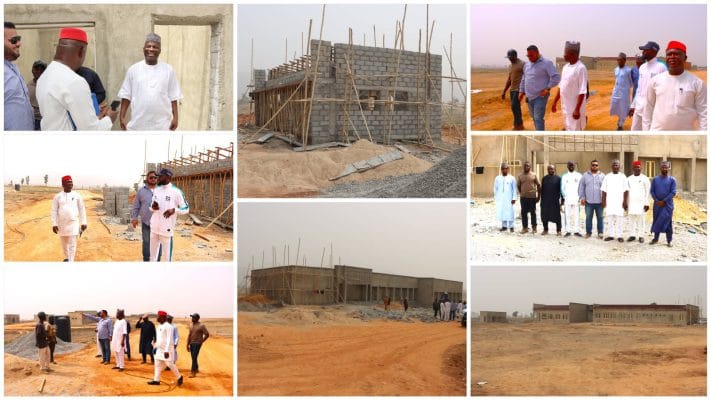
To reverse this challenge, the National Agency for Science and Engineering Infrastructure (NASENI) has commenced the construction of an Agricultural Incubation Centre at the University of Abuja in Gwagwalada. The project, beyond being a physical structure, represents a strategic attempt to re-engineer Nigeria’s agricultural sector through science, technology and innovation (STI).
SPONSOR AD
Across Nigeria’s approximately 923,768 square kilometres of landmass lies an estimated 70 million hectares of arable land, yet less than half is actively cultivated. With a growing population of about 230 million people, the pressure on food supply has intensified.
Most farming activities remain subsistence-based, rain-fed and labour-intensive, leaving productivity low and post-harvest losses high. Rural farmers, who form the bulk of food producers, often lack access to improved seedlings, mechanisation, irrigation facilities, storage and reliable markets. Compounding these challenges is the limited application of advanced research and modern agricultural technologies.
While global agriculture has embraced precision farming, biotechnology, climate-smart agriculture and data-driven production systems, Nigeria still relies largely on traditional methods. Research outputs from universities and institutes rarely translate into practical solutions on farms, creating a wide gap between knowledge generation and real-world application.
It is within this context that NASENI’s Agricultural Incubation Centre initiative becomes significant. Situated on a 10-hectare parcel of land within the University of Abuja, Gwagwalada, the Centre is designed as a technology-driven, commercially viable agricultural hub. The NASENI Agricultural Incubation Centre integrates poultry production, aquaculture, crop cultivation, greenhouse farming and cutting-edge research facilities, including a tissue culture laboratory.
According to the Acting Coordinating Director, Engineering Infrastructure Directorate, NASENI Headquarters and Coordinator of the NASENI Agricultural Incubation Centre, Engr. Dr. Agava Abdullahi Abdulrasheed, the deliberate choice of a university environment underscores the Agency’s commitment to linking research, innovation and production.
“Universities, particularly federal institutions with established agricultural departments, serve as natural ecosystems for experimentation, skills development and knowledge transfer,” he said. “By embedding the Centre within such an academic setting, NASENI aims to bridge the long-standing gap between research findings and practical farming.”
The NASENI Agricultural Incubation Centre is structured around major agribusiness training and incubation hub and three commercially sustainable production units. These include broiler and layer poultry farms, high-tunnel greenhouses for crop production, and aquaculture facilities for catfish and tilapia.
The Centre is supported by modern irrigation systems, solar-powered boreholes and renewable energy solutions; the Centre is designed for year-round production, reducing dependence on seasonal rainfall. Beyond infrastructure, the Centre introduces agritech solutions that reflect global best practices.
Tissue culture technology, for instance, enables rapid multiplication of disease-free planting materials, significantly improving crop quality and yield. Greenhouse farming allows controlled production environments, optimising water use, nutrients and climate variables. Aquaculture systems are designed for efficiency, biosecurity and high output.
“The expected impact on food production is substantial. With integrated systems operating simultaneously, the Centre will contribute to increased availability of poultry products, fish and vegetables within the Federal Capital Territory and beyond. More importantly, it serves as a demonstration and training ground for farmers, students and agripreneurs, exposing them to modern production techniques that can be replicated elsewhere”, added Dr. Abdulrasheed.
Also speaking during an on-site inspection, the Project Manager, Onida Agri and Aquaculture Solutions Limited, Mr. Christian Montano, technical partners to NASENI, said the poultry component comprises a 10,000-capacity broiler unit and 10,000-capacity layer unit, while the aquaculture section features three production tanks, each measuring 16 metres in diameter, with an estimated annual output of about 25 tonnes of fish.
He added that the crop production segment includes 10 greenhouses of 500 square metres each, a 2.5-hectare net house, and four hectares of open-field farmland. He said the tissue culture laboratory is designed to accelerate seedling production and improve crop quality by significantly reducing the time required to propagate planting materials.
Montano noted that the Centre is also equipped with six solar- powered boreholes, power store workshops, irrigation control rooms, and a gatehouse with plans underway to construct a water retention structure to ensure uninterrupted water supply during both rainy and dry seasons.
NASENI has made it clear that the University of Abuja project is not a one-off intervention. Similar Agricultural Incubation Centres are already under development at Bayero University, Kano, with plans to extend the initiative to Abubakar Tafawa Balewa University, Bauchi, and ultimately across the six geopolitical zones.
This zonal spread is strategic, recognising Nigeria’s diverse agro-ecological conditions and the need for region-specific solutions. By situating centres within federal universities across geopolitical zones, NASENI leverages existing academic infrastructure while ensuring nationwide reach. Each centre is expected to adapt innovations to local crops, livestock and climatic conditions, thereby enhancing relevance and sustainability. In the long term, this network of centres could form the backbone of a national agricultural innovation system.
The implications for food security are profound. Increased domestic production reduces reliance on imports, stabilises food prices and cushions the economy against global supply shocks. With improved yields and reduced post-harvest losses, Nigeria can meet a larger share of its food needs locally, improving nutrition and livelihoods.
Equally important is the potential for agro-exports and foreign exchange generation. With quality control, value addition and standardisation embedded into production processes, agricultural products from these centres can meet international market requirements. From processed poultry products to high-value vegetables and fish, Nigeria stands to regain its position as a competitive player in global agricultural trade.
NASENI’s broader mission extends beyond agriculture to industrial renaissance. By applying science and engineering solutions to primary production, the agency seeks to stimulate agro-processing, manufacturing and value chains that create jobs and wealth. The Agricultural Incubation Centres, therefore, function as catalysts for industrial growth, linking farms to factories and markets.
In a country where youth unemployment remains a pressing concern, the Centres also present opportunities for skills development and entrepreneurship. Young Nigerians can be trained in modern agribusiness practices, supported to incubate startups and encouraged to see agriculture as a viable, profitable career rather than a last resort.
Ultimately, the construction of the Agricultural Incubation Centre at the University of Abuja symbolises a renewed commitment to restoring Nigeria’s agricultural glory. It acknowledges past shortcomings while charting a forward-looking path grounded in technology, research and collaboration.
With NASENI effectively implementing and scaling it up, the initiative will mark a turning point, transforming Nigeria’s vast uncultivated lands into engines of food security, export earnings and industrial growth. It is a pointer that the Renewed Hope Agenda of the federal government especially the third priority area on food security is being is being addressed by NASENI.
UPDATE NEWS:
Nigerians can now invest ₦2.5 million on premium domains and profit about ₦17-₦25 million. All earnings paid in US Dollars. Rather than wonder, click here to find out how it works.