


Despite immense talent, Nigeria’s AI dream stalls on power cuts and poor internet.
The darkness didn’t just swallow the light; it ate the last 48 hours of his work.
One second, AI engineer and co-lead of AI Bauchi, Nathaniel Handan, was tracing the training metrics of a Hausa Text-to-Speech model. The next, the generator outside his window stuttered and then fell silent. On his laptop, the progress bar froze, and then vanished into the dark screen, taking the two days of data with it.
His story is not an outlier. It is the norm for millions of Nigerians making ambitious leap into Artificial Intelligence (AI). The cost of this infrastructure abyss is measured in not only in naira spent on expensive fuel, but in lost hours, derailed projects, and the erosion of morale.
“Late last year, I had an important client task with a tight deadline, but constant outages made it nearly impossible to work consistently,” he recounts. “I ended up spending heavily on fuel to keep my generator running. While I managed to meet the deadline, the whole experience was very draining and stressful, and it reminded me of how much infrastructure issues can impact productivity and morale.”
For Handan, electricity interruptions are the bigger challenge than internet connectivity. While his connection is generally stable, the power cuts force him to juggle generators and inverters, a costly and time-consuming decision that still slows progress.
Tochi Ebere, a data scientist at a Lagos‑based fintech startup, tells a similar story. “Accessing cloud‑hosted data, running queries on large datasets stored remotely, or even installing essential packages often take far longer than they should. Many times, the connection drops in the middle of model training or while transferring data, forcing me to painfully restart the process.” she explains.
Nigeria should be leading Africa’s artificial intelligence (AI) revolution. With a young, tech-savvy population and a booming startup scene, its potential is unquestionable. But we must demand answers to why this country continues to hemorrhage billions in economic growth simply because it cannot adequately power, or reliably connect, its own digital space.
The Infrastructure Reality
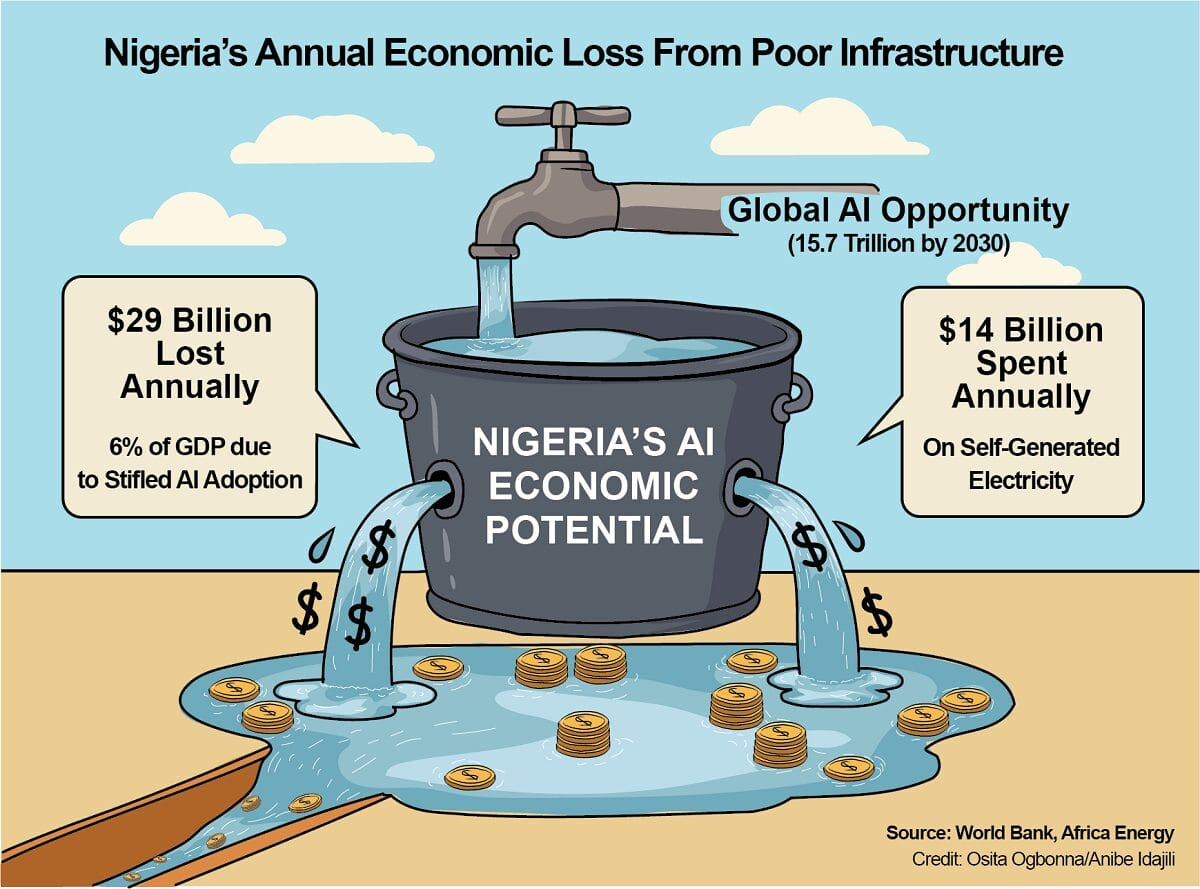
Globally, AI is projected to add $15.7 trillion to the global economy by 2030. In Africa, AI could boost GDP by $1.2 trillion in the same period, if supported by the right infrastructure. For Nigeria, the largest economy on the continent, economists estimate that poor electricity and internet infrastructure could be costing the country $29 billion annually in lost GDP, equivalent to 6% of its current output, due to stifled AI adoption.
The average daily power supply to a majority of Nigerian households and businesses is between 4-10 hours, with some areas experiencing less. This forces businesses to rely on alternative sources for an average of 14-20 hours daily. Nigerian firms spend an estimated $14 billion (₦5 trillion) annually on self-generated electricity. For AI, which demands continuous processing power for data centers, cloud computing, and advanced analytics, this cost is prohibitive.
“Nigeria is trying to build AI on weak foundations,” laments Chidi Nwaogu, a Lagos-based tech entrepreneur and founder of Efiwe, a mobile-first, AI-powered coding platform. “With only about half the population able to access broadband, businesses, farmers, and doctors can’t fully use AI tools, leading to daily lost opportunities in productivity, health, and competitiveness.”
A Nation Running on Generators
In 2023, Nigeria generated only about 4,500 megawatts (MW) of electricity for a population of over 220 million. By comparison, South Africa, with less than a third of Nigeria’s population, produced over 50,000 MW in the same year. This means that over 85% of Nigerian businesses rely on expensive diesel generators, adding up to $14 billion in annual operating costs.
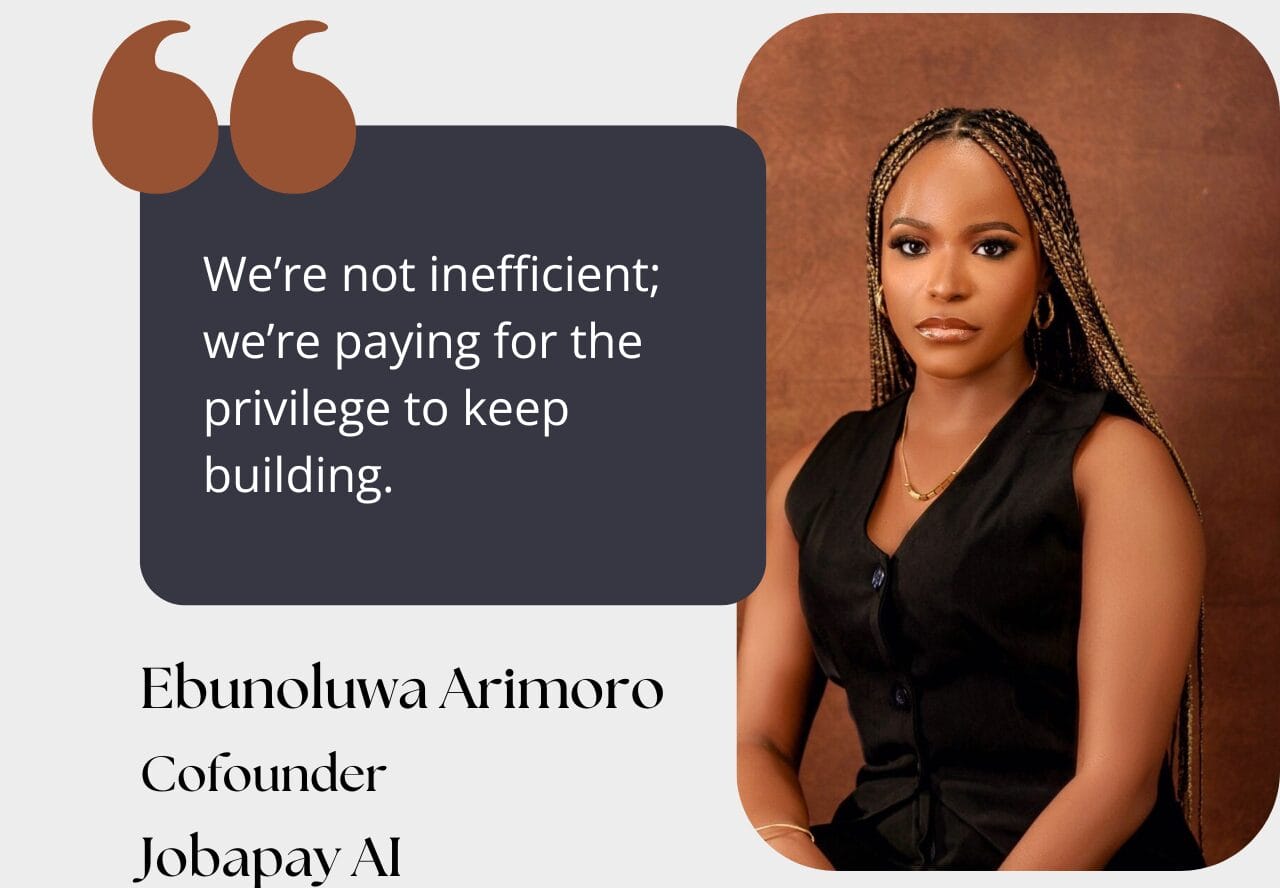
“Our biggest expense is stability; we pay for more than one internet provider because one will fail,” explains Ebunoluwa Arimoro, Cofounder of Jobapay AI, an AI-powered marketplace connecting people with skilled tradespeople and service providers. “We buy extra data plans so we can tether if everything else collapses. We also invest in inverters or solar so we’re not stuck when the power cuts mid-work. Before I even think about AI models or product updates, I’m already budgeting for how to keep the team online.”
Arimoro, like many other Nigerian entrepreneurs, are not only building innovative solutions but also fighting for basic operational continuity.

Draining Nigeria of its brightest minds
The infrastructure gap is triggering a talent exodus. Nigeria produces over 800,000 software developers annually, many with AI expertise. But disillusioned by logistical bottlenecks, many are now looking to relocate.
When Arimoro pitches Jobapay AI to global investors, this question always follows: “Why is your burn rate so high?” “What they don’t see is that a big part of that money is going into surviving the Nigerian infrastructure tax,” she explains.
“We’re not inefficient; we’re paying for the privilege to keep building. But it means scaling takes longer, and raising capital requires more explanation. You spend half your time convincing people your challenges are real before you even get to the product story.”
The Strategic Enablers
While Nigeria struggles, other African nations are sprinting ahead. Kenya’s government has partnered with Microsoft and the UNDP to establish the Africa Centre of Competence for Digital and Artificial Intelligence (AI) Skill, leveraging its relatively stable power grid and 85% internet penetration. South Africa has Project Khulisa, aiming to add 1.2 million jobs through AI and digital services by 2030. Even Rwanda, with a GDP significantly smaller than Nigeria’s, boasts a growing tech sector due to focused infrastructure investments.
Moses Faya, a Lawyer and founder of Tech Policy Advisory, a firm specializing in legal and policy solutions for the digital economy, says the key differentiator is that South Africa, Kenya, and Rwanda have made strategic investments in foundational enablers.
“South Africa has a more mature digital infrastructure and legal environment. Kenya has long been the fintech capital of Africa with strong broadband and innovation-supportive policies. Rwanda, though smaller, has been intentional, integrating technology into governance, education, and even identity systems with strong political backing.”
Faya presses home the frustrating contradiction: “On the surface, Nigeria should be leading the pack. “We have the numbers, over 200 million people, a median age of about 18, and a vibrant youth-driven tech scene. But AI adoption doesn’t thrive on energy and talent alone. It thrives on infrastructure, both physical and institutional, and that’s where the gap widens.”
While these countries leverage strategic investments, Nigeria’s path forward hinges on an often elusive, element: political will.
Where is the Political Will?
Experts advocate for fixing what is broken by fast-tracking the Electricity Act 2023, which allows states to generate their own power and decentralize energy production. They also argue that solar mini-grids and gas-powered plants must be scaled aggressively.
To leapfrog traditional fiber limitations, some advocate for dynamic public-private partnerships, perhaps with innovators like Starlink, especially as the execution of the National Broadband Plan’s target of 70% penetration by 2025 has been sluggish. Others say creating tax-incentivized tech hubs with guaranteed power and high-speed internet could also help retain talent and attract foreign AI investment.
Nwaogu, however, suggests that “Instead of separating infrastructure and AI, the two should be developed together. AI can be used to improve power grids and internet rollout while expanding education on AI tools.”

From a policy standpoint, Faya argues that political will is not just a missing piece but the engine room. He says while there have been some effort as Nigeria does have a National AI Strategy in the works, there is also limited coordination between planning and digital economy goals.
“We have had broadband plans on paper for years. But the execution is where we fall short,” Faya laments, highlighting the gap between ambition and reality. “Let’s start with power. Without reliable electricity, AI infrastructure is a non-starter. Data centres require consistent, clean energy. AI compute needs power, lots of it. Yet, Nigeria’s national grid is unstable, and policies supporting decentralized energy like solar mini-grids or independent captive power for tech clusters haven’t been effectively scaled. There’s also limited coordination between energy planning and digital economy goals.”
On internet access, Faya points out that rural broadband coverage remains weak, and urban bandwidth is not only overpriced but inconsistent. According to him, the National Broadband Plan sets ambitious goals, but enforcement and funding mechanisms are lacking. Spectrum allocation is slow, and right-of-way issues plague infrastructure deployment.
So, What Choice Do We Have?
Nigeria’s immense promise of artificial intelligence for national development collides with systemic inertia. Faya argues that urgent political will, boldly prioritizing AI, is essential. He recommends pressure from stakeholders, including startups, academia, and civil society, demanding action. He also adds that demonstration projects that showcase AI’s transformative power in education, agriculture, and healthcare as well as international incentives from development partners can result in real digital infrastructure reforms.
The country hemorrhages billions in potential economic growth but Nwaogu estimates that “scaling rural electrification alone could attract $9.2 billion annually.” The frustration is captured by Nathaniel Handan’s thought-provoking question: “How long can we keep fighting the system instead of working within one that works?”
Faya warns that, “If we fail to act, we will pay for it in missed opportunities such as brain drain, investor hesitancy, widening inequality, and dependence on foreign platforms. Worse still, we will become consumers of AI built elsewhere, instead of creators shaping it to our realities.”
As Handan plugged in his inverter, he knew the fight would continue tomorrow, but the question remains: If the system won’t turn on the power, will the AI developers finally turn their backs?
This report was produced with support from the Centre for Journalism Innovation and Development (CJID) and Luminate.


