
A hospital in Nigeria has faced public scrutiny for an alleged medical failure following the death of one of celebrated author Chimamanda Ngozi Adichie’s 21-month-old twin sons, Nkanu Nnamdi.
Adichie’s family representative claimed that Lagos-based Euracare Hospital gave her son too much propofol, a sedative, which allegedly resulted in him going into cardiac arrest.
According to the BBC, the hospital denied these claims and said it followed international standards.
The incident raises a question for Nigeria’s healthcare system: whether AI could help address gaps in Nigeria’s emergency care.
Dr. Zain Khalpey, a Zimbabwean-born, US-based heart surgeon and director of artificial heart at HonorHealth, said yes, but pointed out that there is “a lot of bias that exists right now in training of [AI] tools.”
“[Training is] all done on a Caucasian, Hispanic, or sometimes even an Indian population. It’s very rarely done on an Afro-Caribbean population and that’s my worry,” he told Connecting Africa.
Dr. Khalpey, also an assistant professor of surgery at Columbia University Medical Center, said that a “medication dose for a child who is in Africa may be completely or a little different than what it would be for somebody who is in America or the United Kingdom, for example, and that could lead to dangerous things.”
On medication use, he said AI could be particularly beneficial in Africa, especially in Nigeria, where a population of more than 230 million contributes to physician shortages, increasing the risk of medication errors.
Dosing for African children
When asked how medication dosing for African kids differs from that of kids in the US and UK, Dr. Khalpey said, their “metabolism is a little different.”
He explained that Afro-Caribbean people in the US respond better to simple things like a blood pressure medicine called thiazide diuretics, which sometimes treats fluid buildup (edema) in conditions like heart failure.
He warned against a “simple calcium channel blocker or a beta blocker,” which helps blood vessels stretch out so the heart doesn’t have to work as hard, adding: “thiazide diuretics are better for our patients [who are] Afro-Caribbean.”
Dr. Khalpey believes there are many populations and differences that are unknown, and is calling for “proper trials” to assist in medicine and also for AI usage.
He said so far, HIV trials conducted in South Africa and Nigeria have been among the “safest” and help doctors look at kidney clearances of medication.
His solutions for serving an under-researched population in Africa are through the creation of digital replicas.
“What’s cool about AI is that you can use [Food and Drug Administration] tools, and you can de-risk the population by creating digital twins … and that’s what we’re doing. We create these digital twins, and we can de-risk and profile any phenotype of patient that you want,” he told Connecting Africa.
Further, he explained, AI would be taught to think of a Nigerian child versus an American Caucasian child, who would have a different kidney clearance of a certain drug.
“If you train the AI right, it would automate that into its formula before giving the drug in Nigeria, which means you would reduce the error rates in Nigeria,” he added.
AI offers opportunities in Ghanaian hospitals
Sylvia Adzitey, a registered nurse at the Tamale Teaching Hospital in Ghana, said she doesn’t currently use AI in her clinical practice.
However, she is “hopeful that AI can help bridge the healthcare gap in Africa in terms of access to care, regardless of a person’s location and socio-economic status.”
Adzitey also serves as professional development and advocacy co-lead at the Ghanaian-Diaspora Nursing Alliance and said there are other gaps in healthcare that AI can fill, such as charting, which she said can be time-consuming.
“I believe AI can assist with nursing documentation. Nursing documentation is one area that takes [up a lot of nurses’ time.] With existing challenges of workload and nurse-patient ratio, anything that can help reduce time spent on documentation will help the nurse get adequate time taking care of patients’ critical care needs,” she told Connecting Africa.
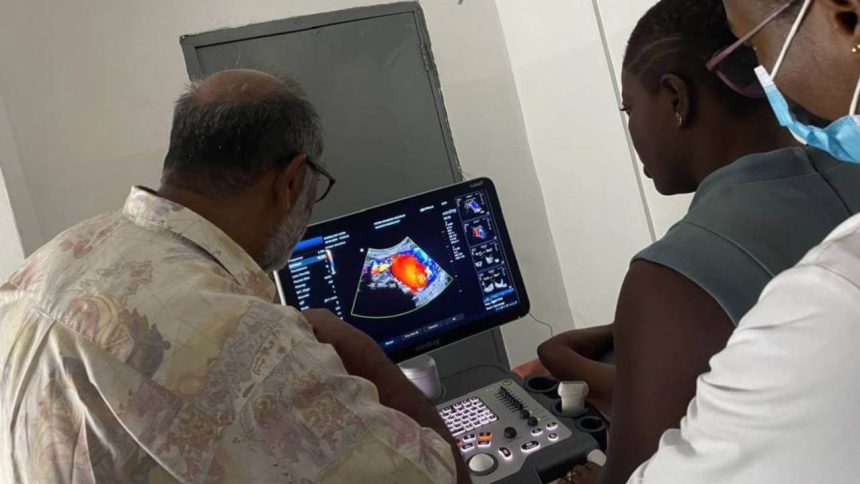
Seth Quansah, co-founder and CEO of InstantRad, a company that digitizes radiology departments in Africa, said he uses AI in a clinical way, among other things.
“The clinical aspect is we want AI to become like this 24-7 secretary, [like an] assistant … who is helping the radiologist to analyze the scan that is in front of them to reduce their turnaround time in reporting,” he said.
.jpg?width=1280&auto=webp&quality=80&disable=upscale "An InstaRad chief sonographer shows students scans on a screen.")
An InstaRad chief sonographer with students. (Source: InstantRad)
Quansah said InstantRad operates in Ghana, Nigeria, Cameroon and Liberia and that healthcare problems aren’t unique to Nigeria. However the speed of intervention is critical, which is why AI could help fill gaps.
“One of the things about healthcare in Africa is the timing. Timing is probably one of the major risk factors,” he told Connecting Africa.
AI don’ts in healthcare
Dr. Khalpey warned against artificial general intelligence (AGI), saying it “shouldn’t be in healthcare just yet.”
AGI is a type of AI that aims to mimic the cognitive abilities of the human brain.
Dr. Khalpey said advanced AI models like Gemini (Google), Claude (Anthropic), and Grok (xAI) have Humanity’s Last Exam tests, which are used to test the limits of math, science and other subjects. These questions are taken by professionals.
“It’s a very, very hard exam, which these computers have not seen before, but asks the most difficult questions known to man. Then if they pass them, then that’s a sign of artificial general intelligence, which is somebody more intelligent than me,” he said.
“So, in order to go to superhuman medical intelligence, if you pass these tests, you should be fine. But guess what? If your mom or dad was sick, and they came to me, I could pass a test book exam, but not be a good doctor,” he added.
The Gates Foundation and OpenAI are partnering to help bolster Africa’s healthcare system with a new US$50 million initiative, called Horizon1000. Rwanda will be the first country to participate in the program.
However, the partnership was met with backlash, according to reporting from Business Insider Africa, which highlighted fears from people who claimed that “the enemy will come as an angel of light,” referencing colonial behavior.
While Dr. Khalpey didn’t address the Gates partnership directly, he did say anyone coming into Nigeria or anywhere in Africa still carries “a colonial sense.”
“Africa is its own goldmine, but you can’t let other people come in and take it. That’s neocolonialism. What you need to do is you need to grow that within your system,” he told Connecting Africa.
“People come with their new technologies or their new toys, or in the olden days with their power tools … and [say] that ‘you should use this because it’ll help,'” he explained.
Dr. Khalpey stressed the importance of African solutions being created by Africans and those who have a seat at the table, because they understand their population better than anyone else.
Dangote call to action
Asked if he could speak to Africa’s richest man, Aliko Dangote, whose net worth is estimated at $26 billion, to support his deployment of AI to improve Nigeria’s healthcare system, Dr. Khalpey said, “absolutely.”
“Everybody wants to make it good for their people. Because what he needs to think about doing, [because] money’s not an object, is leaving a legacy and doing the right thing, which would take Nigeria to be a leader in the world,” he said.
“So, if you were to tell him this could be Nigeria’s atomic moment in healthcare, and this is what could change Nigeria for the future, for many years to come,” he told Connecting Africa.