

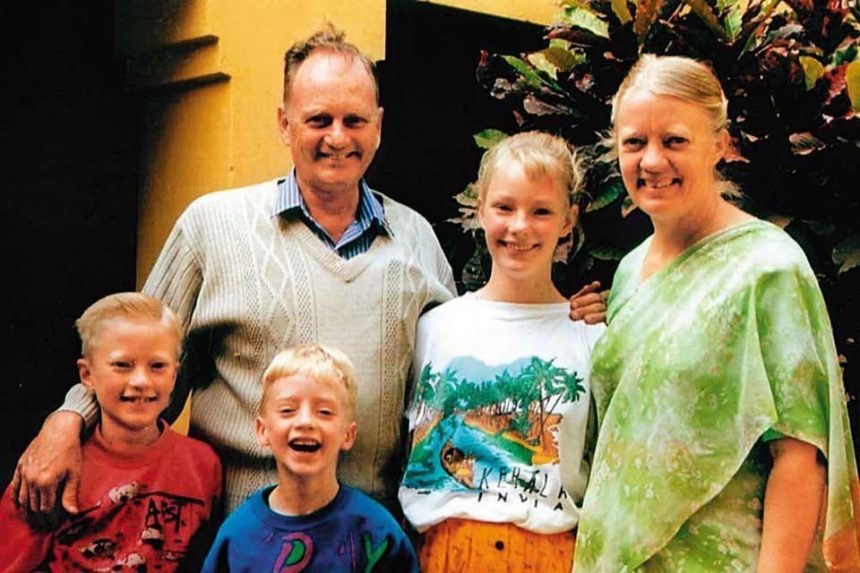

On the 27th year anniversary of Australian missionary Graham Stuart Staines’s and his two young sons’ murder by Hindu extremists in Odisha State, India, we look at what widow Gladys Staines offered India: not a theological argument but a moral mirror.
On the night of January 21–22, 1999, in a forest village in Odisha, Graham and his two sons — Philip, aged 10, and Timothy, aged 6 — were burnt alive while sleeping in their jeep. Last April, the murderer, Mahendra Hembram, was released from prison after serving only 25 years of a life sentence. And despite the brutal murder, he received a hero’s welcome in Keonjhar.
Staines’ work was not episodic charity or public spectacle. It was a sustained presence: medical care, accompaniment, and dignity. He stayed where others passed through. He served people India had already decided were expendable. That alone should have commanded respect. Instead, it made him vulnerable.
India remembers the brutality. It prefers to forget the meaning
What followed the murders should have unsettled the nation more deeply than the crime itself.
Graham’s widow, Gladys Staines, spoke words that did not fit the political or emotional grammar of the moment: “I forgive those who burnt alive my husband and my two innocent children.” She did not offer this once for the cameras, but she repeated it calmly, consistently, and lived by it, remaining in India for years to continue to serve people affected by leprosy, refusing both hatred and flight. This was not weakness. It was not submission. It was not silence. It was moral resistance of the most unsettling kind.
India understands anger. It knows how to valorize outrage, especially when wrapped in religious or nationalist language. It knows how to convert violence into grievance and grievance into mobilization. What it does not know how to handle is forgiveness that refuses to cooperate — forgiveness that does not erase suffering, does not withdraw the demand for justice, and does not ask permission from the powerful.
Gladys Staines did not compromise the legal process. The case went forward. The principal accused was convicted. Forgiveness did not cancel accountability. It exposed something more disturbing: that a society intoxicated with righteous fury is deeply threatened by grace.
The Staines family members were not agitators or provocateurs. Graham’s work among people with leprosy was deliberately unheroic. It was quiet, repetitive, and patient. It involved bodies most people refused to touch and lives most institutions refused to count. There were no slogans in his work, no confrontations, no public challenges to the state. Yet even this kind of presence proved intolerable to those who believe violence is a legitimate form of cultural defense.
The killings were not an aberration. They were an early warning. They signaled the emergence of a politics in which vigilante violence would be excused as sentiment, and minorities would be told — sometimes politely, sometimes brutally — that their lives were conditional.
More than two decades later, the warning has proved prophetic.
What Gladys Staines offered India was not a theological argument. It was a moral mirror. Her forgiveness asked an unbearable question: What kind of nation are we becoming if mercy unsettles us more than murder? Why does forgiveness feel like betrayal in a civilization that claims ancient spiritual depth?
Forgiveness, in this case, did not sentimentalize loss. It named it. It did not deny pain. It carried it without allowing pain to become poison. It stripped violence of its final ambition — the power to define the moral horizon.
I knew Graham Staines personally. He was not dramatic. He was not loud. He did not think of himself as brave. That is precisely why his death and his wife’s response continue to matter. They puncture the myth that cruelty is strength and expose the poverty of a politics that needs enemies to feel secure.
Martyrdom is an uncomfortable word in a secular republic. But if it means anything at all, it means this: a life given in service to the most abandoned, taken by violence, and answered by forgiveness that refuses to become violence’s echo.
India does not need to share the Staines family’s faith to learn from their witness. It only needs the honesty to admit that the real scandal was never forgiveness. The real scandal was that it was necessary at all.
Rev. Dr. Richard Howell is the founder President of Caleb Institute. And Chairman of Evangelical Church of God established in 1977. He is the former General Secretary of Evangelical Fellowship of India. (1997-2015) and of Asian Evangelical Alliance for ten years. He was Vice President of World Evangelical Alliance of Four Years. And a founding member of Global Christian Forum.